
NEW YORK — As Frans Muller prepares to step down as president and chief executive officer of Ahold Delhaize next March, he has reason to look back with satisfaction at the growth and evolution of the company he played an instrumental part in forming a decade ago. On one of his regular trips to the United States, the source of more than 54% of the Zaandam, Netherlands-based company’s sales, Muller sat down to talk about Ahold Delhaize’s past, present and future.
“By bringing the two companies together, we are much stronger than before,” said Muller, who prior to the merger was president and CEO of Delhaize, the Belgian supermarket operator. “It's not only about sheer scale and procurement and synergies. It's also understanding of the markets and bringing talents together. We have greater economic strength and a stronger balance sheet. We now invest €2.7 billion every year, 3% of sales of €92 billion (or more than $105 billion).
“The things we have done in the U.S. we could not have done alone as Delhaize America or Ahold USA. On the East Coast, we are the biggest traditional grocer, with 80% of our sales generated in DMAs where we have the No. 1 or No. 2 position. And there's more to come.”
Beginning in March, Ahold Delhaize will be charted by new leaders. Muller will be succeeded by Thierry Garnier, who previously served as CEO of British retailer Kingfisher. Claire Peters, a former Amazon executive, took the reins at Ahold Delhaize USA in September. And a month later, Margaret Versteden-van Duijn became CEO of the company’s operations in Europe and Indonesia, after leading bol.com, Ahold Delhaize’s thriving ecommerce business in The Netherlands and Belgium.
"It's normal in the lifetime of a company that you have changes on senior levels,” said Muller. “It's also good. I have been here the last 12 years, and in this specific role, eight by 2027. So it's normal that people rotate and take on new things. It's quite some change.”
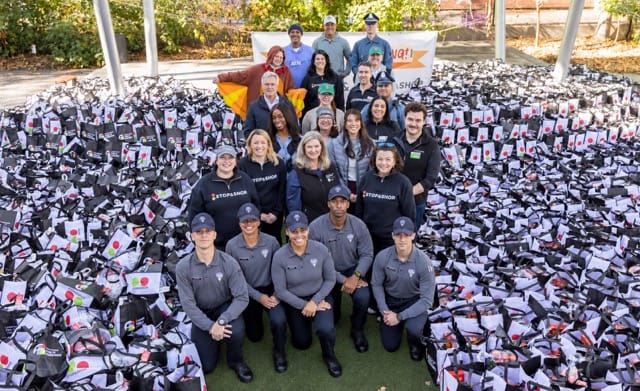
Muller is confident that the investments Ahold Delhaize has made in recent years put the company and its 17 brands – including Stop & Stop, Food Lion, Hannaford, Giant Food and The Giant Company in the U.S. – in an advantageous position. He said he expects the company to continue to make inroads in the markets where it now competes.
“We have requirements for return on capital,” Muller explained. “We have hurdle rates, how we measure and are gating our investments -- in store modernization, IT, and new stores or acquisitions. We are very happy with our U.S. performance. In the third quarter, we gained market share and saw good volume developments. It was a quarter where we grew 14% in ecommerce, which was one of the areas where we made significant investments.
“We did quite a lot of work to streamline our organization over the years and strengthen our own brand proposition, all of which helps improve the customer value proposition. But there's always more to do in retail; there’s never a moment when you can sit back and say, okay, this goes by itself. You have to work hard at this.”
One of the pressing issues that Ahold Delhaize and other retailers must grapple with is the unsettled geopolitical situation, with its attendant threats to the global supply chain, according to Muller. Another is the emergence of the so-called K-shaped economy.
“We see that more and more households are stretched, both in Europe and the U.S.,” he said. “Economic polarization is taking off. That’s not good for living together -- the haves and the have-nots.
“We have a role there to play as a food retailer. You have to make sure that in your assortment you have offerings for everybody. You have to service both types of customer. Value is getting more important, and you can show value in your national brands, but you mainly can show value in your own brand.”
Ahold Delhaize excels at store brands. Private label products account for 32% of the company’s sales in the U.S. and 50% in Europe. In addition to providing value for customers, store brands are a resource for merchants.
“Own brands represent an opportunity to give customers choice,” Muller said. “The beauty about your own brand is it’s your brand so you can differentiate. If the specs of a product are different, the customer can only get those specs with us. You can do work on value, you can work on organic, you can work on gluten-free, you can work on high fiber and those kinds of things. Own brands are a nice opportunity to differentiate yourself.
Muller indicated that he expects to see further consolidation among U.S. grocers. The company will keep an eye out for opportunities that make sense, particularly on the East Coast, where its existing store are located.
“What we always say is, the best way of growing is more sales through the same doors; it's the most profitable,” he noted. “The second best thing is more stores in your present geographies; people know your brand and you have a supply chain in place. Third best is adjacent markets.”
Looking forward, Muller pointed out several areas where the investments made as part of Ahold Delhaize’s Growing Together strategy give it a competitive edge.
“It’s reasonably clear is that ecommerce penetration and growth will go up, just because customers want that,” he said. “With the emergence of AI and agentic commerce, the market must find the right way to benefit from that. I'd rather see this as an opportunity than as a threat.
“There will be higher own brand penetration in the U.S., because consumers recognize that own brands are not like they were 20 years ago, when they were perceived as cheap and bad quality. Today there are a lot of super strong own brands at retail.
“We’ll also have to deal with changes in demography. Elderly people’s share will go up, along with single households, smaller families. That means you need to look at meal solutions and convenience, which will be a growing element. That positions Ahold Delhaize quite well as a company that has 2,000 stores along the East Coast. So we are quite close to consumers who want either an in-store or ecommerce experience.
“The last dimension I would call out is health. The health component will not only be in the mindset of elderly people, but also younger consumers. If you talk about single household and smaller families, there might be a little bit more money available for health, too. That is also in the line with where we are positioned. We have big fresh departments and we can work with all types of diet and these kinds of things. It's a big opportunity for us.”
Muller expressed confidence that whatever tasks Ahold Delhaize undertakes, the talent and commitment of its workforce will ensure that the company continues to thrive: “Something that has made me happy throughout the years is that our teams have been extremely resilient. Resilient in dealing with crises like COVID, like hurricanes, like floods, like the K-shaped economy, like doing the best for communities. The spirit of our people, the values of our people, the resilience of our teams in difficult circumstances is remarkable.
“We have a good plan in place, and my successor will give it another spark of energy. It’s always good to get the team behind you and rally around new things.”
Submit Your Press Release
Have news to share? Send us your press releases and announcements.
Send Press Release