

NEW YORK — Year-end holiday shopping is proving to be significant boost for social commerce, a rapidly growing subsector of e-commerce. A report released today by Emarketer suggests that social commerce will grow by double digits through the remainder of the decade. A notable portion of that growth is projected to come from TikTok.
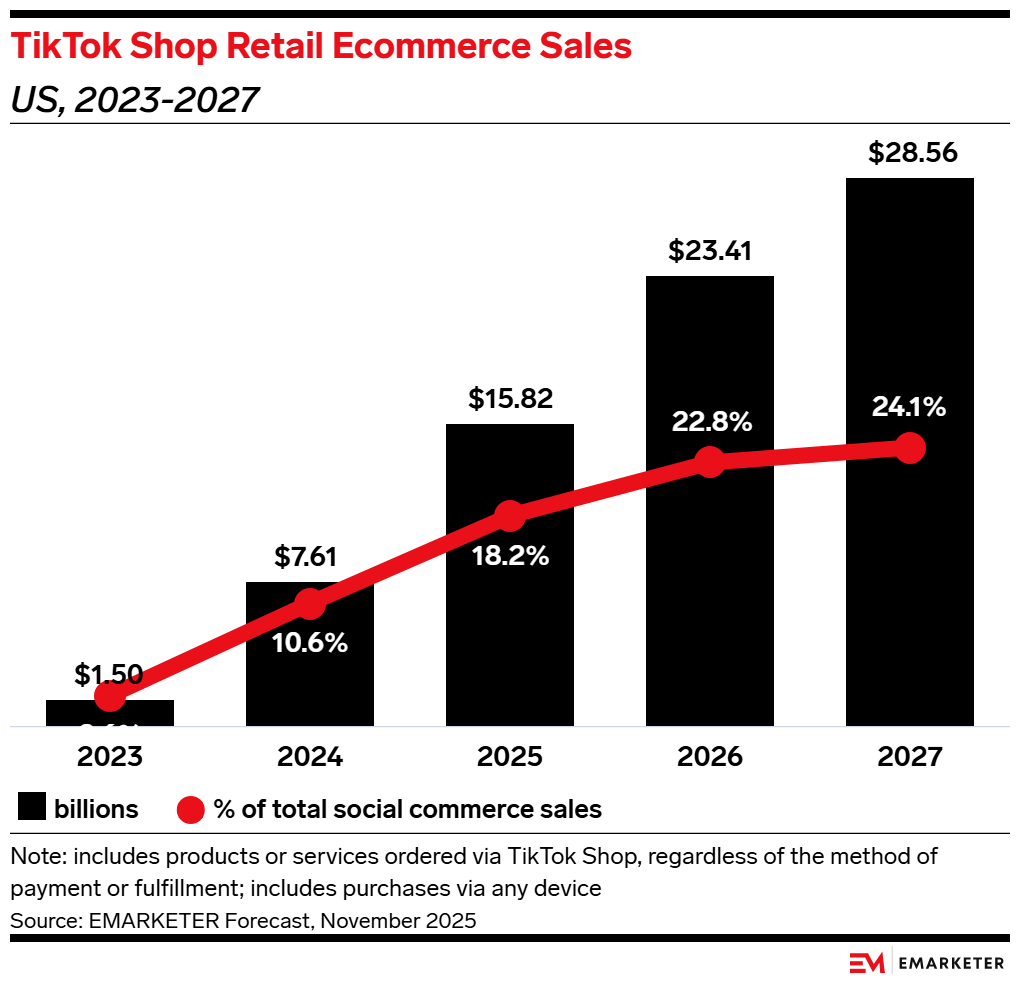
Since its U.S. launch in September 2023, TikTok Shop has become a social commerce juggernaut, according to Emarketer, which finds that its U.S. sales increased 400% in 2024 and another 108% this year to reach $15.8 billion. The firm says that’s good for an 18.2% share of U.S. social commerce. Facebook Marketplace and Instagram remain the dominate players in the subcategory, collectively accounting for about 75% of activity.
Emarketer defines social commerce as the sale of products or services ordered by buying directly on a social platform, or through clicking links on a social network that lead to the retailer's product page and a purchase option. It excludes things like travel and event tickets and the purchase of "vice" goods.
“TikTok ability to blend shopping and entertainment is turning the platform into an ecommerce powerhouse,” says Rachel Wolff, retail and ecommerce analyst at Emarketer. “While price concerns and value are top of mind for consumers this holiday season, so too is the desire to shop for fun — an itch that TikTok Shop is perfectly placed to scratch.”
Adds Wolff, “TikTok Shop has used its social influence to become a hyper-effective product discovery and recommendation engine, while also plowing money into discounts and incentives to increase its appeal to buyers and sellers.”
TikTok’s Beijing-based parent, ByteDance, launched the site looking to at least partially replicate the success of TikTok’s sister app in China, Douyin, which last year notched e-commerce sales of nearly a half-trillion dollars. An estimated 40% of Douyin’s daily active users participate in or view livestream shopping events, a format that is growing here but at a much slower pace.
Although social commerce still represents a small percentage of the retail ecommerce pie (6.9%), its share is steadily increasing. Emarketer projects it will hit 9.3% in 2029. U.S. social commerce sales will amount to $87 billion in 2025, up 21.5% year over year. In 2026, social commerce sales will grow another 18% and surpass $100 billion,
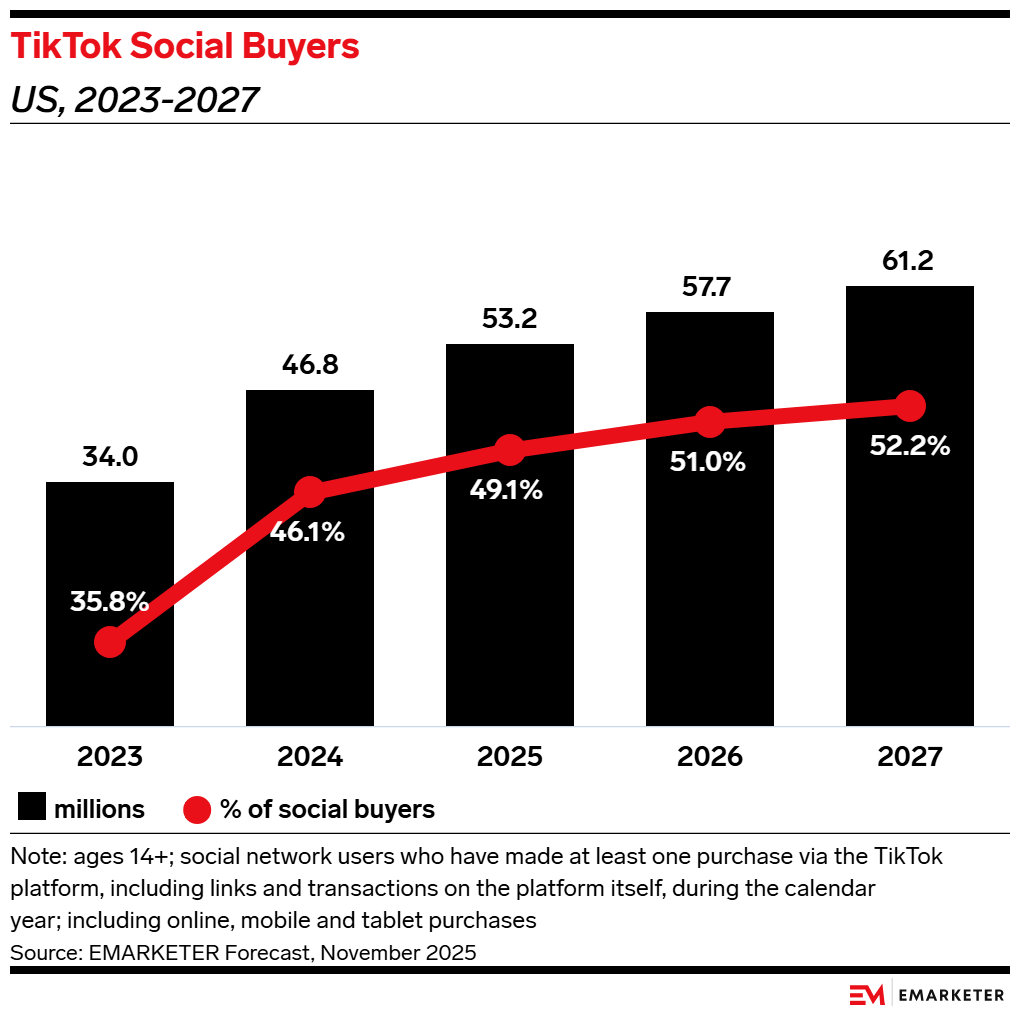
TikTok Shop’s user base skews young and discovery-driven, with much of the research agreeing that growth is primarily coming from Gen Z and millennial adoption, according to Oscar Orozco, senior forecasting director at Emarketer. “Health, wellness, and beauty are top categories, followed by accessories, household items, fashion, and cosmetics, according to our research,” he says. “TikTok Shop’s best-selling items combine low price points, spur-of-the-moment appeal, and trendiness, and rely heavily on strong creator amplification.”
Wolff attributes some of the growth to the increasing amount of shoppable content, including livestreams featuring celebrities like Kim Kardashian and John Legend, which get more users accustomed to the idea of social shopping and encourages them to make impulse purchases as they scroll through their feeds.
“When it comes to social commerce, TikTok Shop has few rivals,” Wolff said. “No other platform, except perhaps Pinterest, has the same ability to facilitate product discovery and inspire users to shop. To maintain its dominance, TikTok will have to attract more household names to its platform, which should get easier the larger it grows. The pending sale of TikTok US to a consortium of investors could challenge the company’s ecommerce ambitions, although reports that ByteDance will maintain control over that side of the business could make a transition less disruptive.”