

NEW YORK — Grocers continue to look for ways to strengthen customer loyalty, and fuel rewards programs remain a popular strategy among grocery chains and mass retailers seeking to add value beyond the store.
Industry observers note that fuel rewards programs have become increasingly important as consumers look for ways to stretch household budgets. By pairing grocery purchases and memberships with savings at the pump, retailers can offer a tangible benefit that resonates with customers while differentiating themselves in a highly competitive marketplace.
“Fuel only represents about 3% to 4% of the average household’s annual spending, but it punches above its weight in consumers’ minds because it’s a highly visible, recurring expense. Every trip to the pump is another opportunity for retailers to reinforce loyalty by turning grocery spending into immediate, tangible savings,” said Katherine Black, partner in the consumer practice of global management consulting firm Kearney, where she leads food, drug and mass market retail.
“When the gas station is adjacent to the store, it is also a great trip driver. Increasingly, consumers are using delivery for urgent needs, and this market is growing rapidly, but when the consumer needs to fill up on gas and there is a store adjacent, they will often bundle the store visit with the fill-up instead of turning to quick delivery,” she added.
Several major supermarket chains have integrated fuel savings into their loyalty offerings, allowing shoppers to earn discounts on gasoline through everyday purchases. The programs not only provide customers with a financial incentive but also help retailers build stronger relationships with shoppers by encouraging repeat visits across multiple channels.
Stop & Shop operates 98 fuel stations adjacent to its stores across its market area. In addition, the chain partners with Shell stations throughout a five-state footprint that consists of Massachusetts, Rhode Island, Connecticut, New York and New Jersey, allowing customers to redeem fuel rewards at a broad network of locations.
“The fuel savings program is connected to Stop & Shop’s GO Rewards loyalty program. Customers must first enroll in GO Rewards, after which they earn one point for every $1 spent on eligible purchases, both in-store and online,” explained Daniel Wolk, external communications manager at Stop & Shop. “Customers can then redeem points for savings on fuel or groceries. When it comes to fuel, every 100 points equals 10 cents per gallon in savings. GO Points are valid for 30 days, with the date of purchase counting as day 1.”
He added that for a single fuel transaction, customers may redeem up to 1,500 GO Points, which provides a discount of up to $1.50 per gallon on a maximum purchase of 20 gallons.
“This program is one of the many ways Stop & Shop helps customers save on everyday purchases while extending value beyond the grocery basket,” he concluded.
Kroger has taken the concept even further, operating more than 1,000 dedicated fuel centers across its network. The company links its fuel rewards program to purchases made throughout its stores, enabling customers to accumulate points that can be redeemed for discounts on gasoline. The extensive fuel network has become an important component of Kroger’s broader customer loyalty strategy.
The company recently announced that rewards program members now have more flexibility in how they use their rewards. Members can redeem their points for dollars off groceries in-store and online, in addition to fuel discounts at the pump. Fuel Points are simply Points, giving members the freedom to choose how they save. This is one more way Kroger is making shopping simpler and more flexible, helping customers save in ways that fit their needs.
“We’re excited to help customers stretch their budgets and give more choices in how they use the rewards they earn shopping with us,” said Megan Shaffer, group vice president of customer growth and strategy at Kroger. “Whether they’re saving up to $35 on their next fill-up or taking dollars off their grocery bill, customers can now choose the savings that matter most to them.”
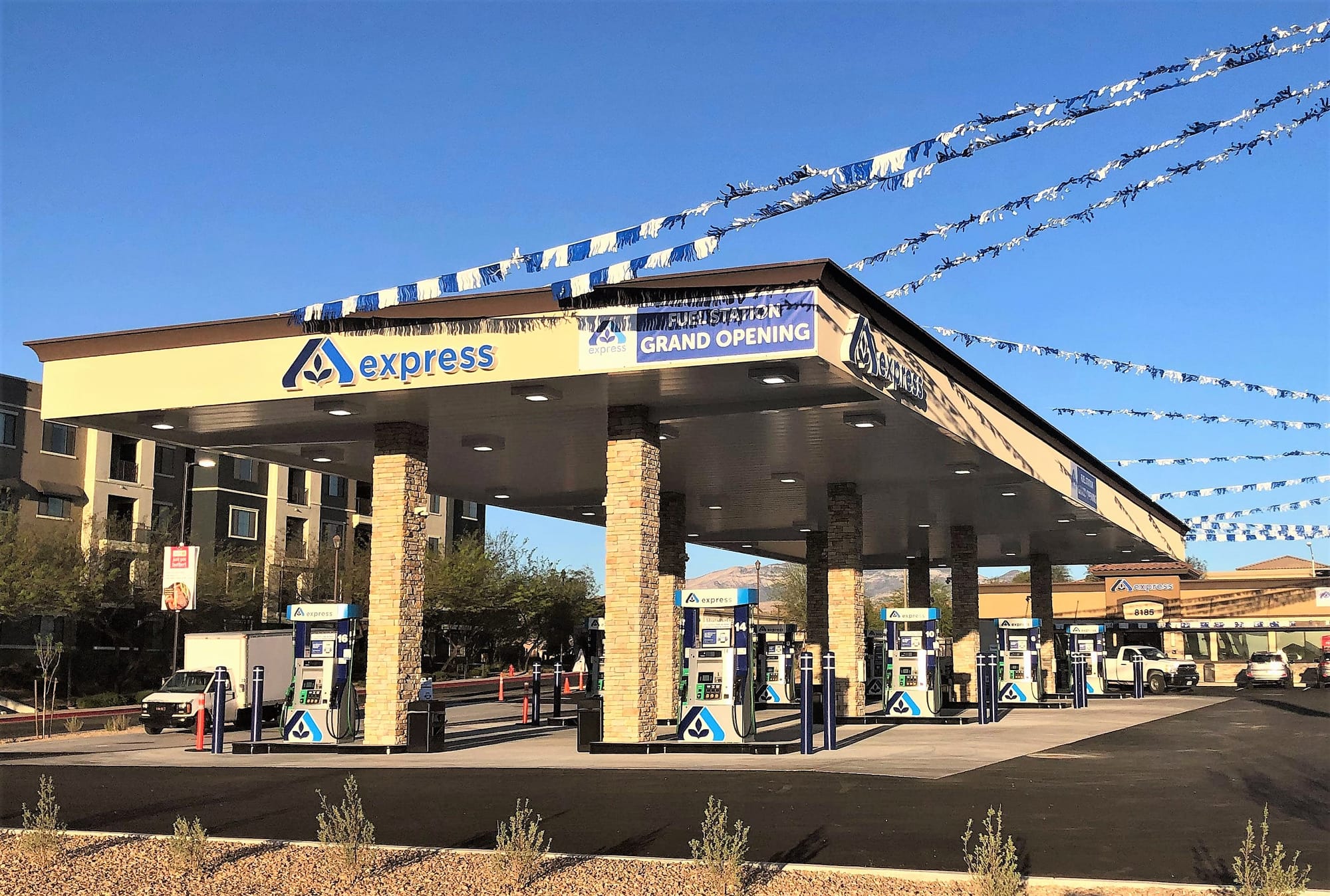
Albertsons Cos. operates 408 associated fuel stations across its banners, helping customers save on everyday fill-ups while adding convenience to their shopping experience. Through Albertsons’ free for U loyalty program, customers can earn and redeem fuel rewards at participating fuel stations, with savings of up to $1.00 off per gallon. Customers can access additional fuel savings through Albertsons’ long-standing partnership with Chevron and Texaco, creating even more opportunities to save on both groceries and fuel.
Walmart has expanded its fuel presence at selected Supercenter locations, where adjacent fuel stations provide added convenience for customers. Through the retailer’s Walmart+ program, members can receive per-gallon discounts at participating fuel locations, further enhancing the subscription service’s benefits.
Warehouse clubs have also made fueling up a cornerstone of their membership value proposition. Costco and Sam’s Club are known for offering highly competitive fuel prices that are available exclusively to members. Their gas stations are typically located adjacent to warehouse stores, creating an additional incentive for shoppers to maintain memberships and consolidate shopping trips. Costco operates more than 600 fuel stations globally, with roughly 580 located in the United States and over 700 worldwide across its total warehouse network. Over 500 Sam’s Club locations have fuel stations as well.
Amid rising demand, Costco is testing a new retail format with stand-alone fuel stations. The company’s first U.S. stand-alone gas station opened in June in Mission Viejo, Calif. The 40-pump facility sits about 50 miles south of downtown Los Angeles.
As retailers continue to refine loyalty programs and expand convenience-focused services, fuel rewards are expected to remain a key tool for attracting and retaining shoppers, particularly in regions where consumers frequently rely on personal vehicles for daily transportation.
Submit Your Press Release
Have news to share? Send us your press releases and announcements.
Send Press Release