

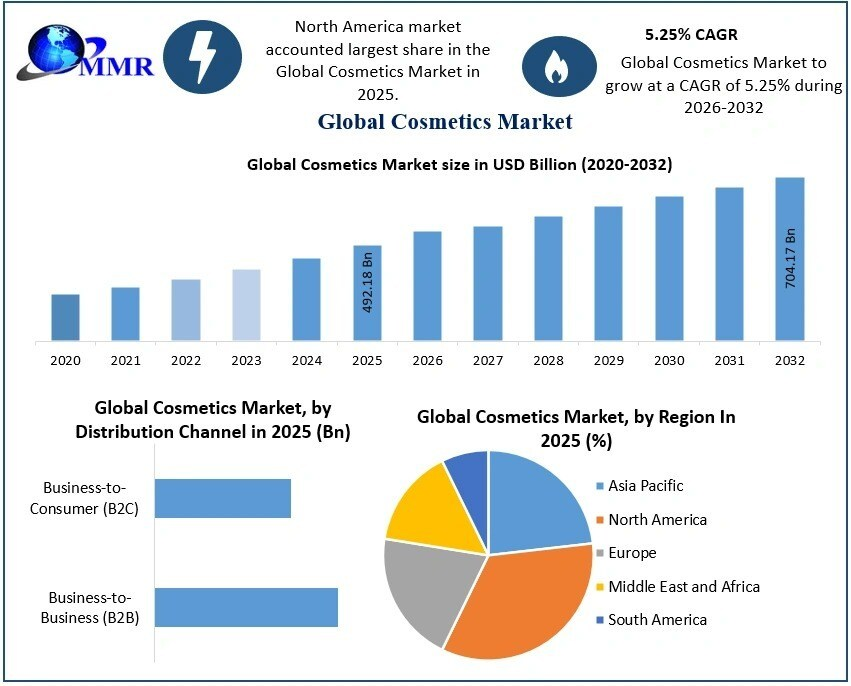
PUNE, India — The global cosmetics market is projected to reach $704.17 billion by 2032, up from $492.18 billion in 2025, reflecting a 5.25% compound annual growth rate, according to new analysis from Maximize Market Research. Much of that momentum is being shaped by U.S. consumer demand, AI-enabled personalization and accelerating premium skincare adoption across mass retail channels.
Skincare Leads, U.S. Drives Premium Growth
Skincare made up 48% of global cosmetics revenue in 2025, with the U.S. market continuing to lead that share. American consumers still focus on anti-aging products, dermatologist-recommended routines, SPF-included daily products, and microbiome-friendly formulas.
For mass retailers, this translates into strong velocity in:
- Serums and treatment-based formats
- Barrier-repair moisturizers
- Sun care and hybrid SPF cosmetics
- Acne and sensitive-skin solutions
Premiumization remains a defining theme, with shoppers trading up to science-backed formulations and ingredient-forward positioning.
Artificial intelligence is increasingly embedded in the U.S. beauty shopping journey. Global leaders, including L’Oréal, Estée Lauder and Shiseido, are scaling AI diagnostics, virtual try-ons and personalized product recommendations across digital and in-store platforms.
Mass merchants are leveraging:
- AI-powered shade matching
- Skin analysis tools
- Personalized regimen builders
- Augmented reality try-on kiosks
These capabilities are strengthening omnichannel engagement, increasing conversion rates, and supporting higher-margin assortments.
U.S. consumers continue to boost demand for cruelty-free, vegan, and plant-based products. Sustainable packaging efforts, such as refillable formats and recyclable materials, are becoming more prevalent in mass retail settings.
Retailers are also expanding ingredient transparency initiatives, strengthening consumer trust and helping long-term brand differentiation.
Growth opportunities go beyond traditional female-focused categories. Men's grooming is growing in popularity, especially in anti-aging skincare and daily routines. Meanwhile, inclusive shade ranges and gender-neutral marketing are expanding the category’s reach.
Business-to-consumer channels remain dominant, with online retail and social commerce boosting discovery. Hybrid beauty products like tinted moisturizers with SPF and serum foundations show the merging of skincare and color cosmetics.
Major players active in the U.S. include Procter & Gamble, Revlon, Beiersdorf, Henkel and Amway, alongside emerging digital-first brands.
North America, led by the U.S., remains the largest regional cosmetics market. AI-powered diagnostics, clean-label positioning, and science-driven skincare are reshaping category growth across mass retail. As retailers balance innovation, sustainability, and value, the U.S. market will continue to influence global beauty strategies through 2032.