
AI is revamping retail operations, and two experts at the NACDS Regional Chain Conference enumerated five consequences to expect in the next year and a half.
Sean Ammirati, co-founder and CEO of Growth Signals, said that the adoption of AI is a transition “we’re clearly in the middle of right now.”
“Three years ago, none of you knew anything about how to do this,” Todd Huseby, Chicago office and health care sector leader for Kearney, told retailers at the conference. “And you’re all picking it up, and it’s integral to the way we live now.”
Ammirati and Huseby forecast these changes by the middle of 2026:
AI Will Be the Front Door to Demand
Consumers are spending their time in generative AI chat windows, not “check windows.” Consequently, if that’s where the consumers are, then brands need to engage consumers there. Fifteen to 20 years ago, brands started to get smart about search engine optimization (SEO) in order to get their products in front of consumers on search engines like Google. Nowadays, increasingly, when consumers are instead on ChatGPT or Gemini, brands need to get capable at “LLM optimization” so that they can position their products on those platforms. This will take time and learning. But it’s coming fast, so brands need to build those capabilities.
Ammirati gave an example from the Carnegie Mellon applicant pool. He noted that 20% of the applicants were referred to the university from their engagement with ChatGPT. He pointed out that such referrals were 0% just a few years ago. That’s a lesson that customers will increasingly rely on GenAI to recommend products or services to their users.
Agents Will Run the Work
They will do so for the next 12 and 18 months “more and more,” said Huseby. “And I think the next leap is not just the fact that there are agents doing the work but, as digital workers in your environment, they will be working with each other, handing off work from one agent to the next. And with that you need orchestrator agents who are able to take your goal and start to break it down into tasks and hand them off to other agents to start to do that work and feed it back to the human — the boss. We’re already starting to see teams of agents coordinate in order to be able to work towards goals.”
One implication of agents doing jobs is “an emerging workforce — whether you want it or not — of digital workers with all sorts of benefits and opportunities, but also with risks that come when those agents decide to go do things that maybe you are responsible for.”
New hires will inevitably have their own agents, as will employees who are fired. “You’re going to have to decide who gets to keep those agents. You’re going to have to manage from an HR perspective, not just human resources, but also digital resources. That’s a paradigm shift that’s coming over the next couple of years.”
AI Will Enter the Physical World
Robotics at Amazon warehouses is a leading example of that, noted Huseby. “Think about when one robot learns something new that no other was aware of; immediately they all learn. The training is just a different paradigm than the world we’ve all grown up with as humans.”
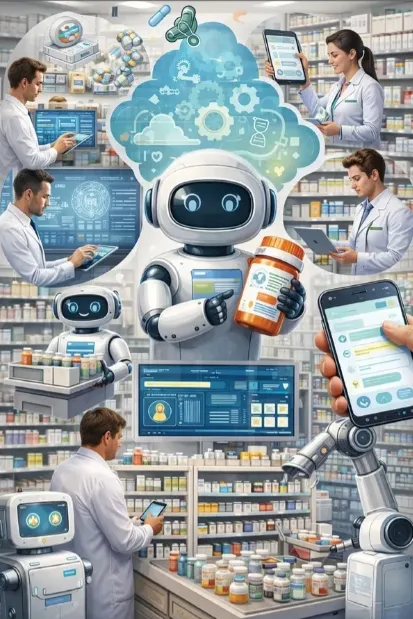
Ammirati said the same principles apply to central fill pharmacies, pointing out that up-front capital expenses are starting to become very favorable. “So it’s inevitable that as a manager you’re going to be confronted with that question of the robots being cheaper than people, so what do I do? It’s coming, and it’s coming pretty quickly.”
Decisions Will Be Simulated and Tested First
Huseby said a lot of consulting hours can help people work through high-stakes decisions. But now, for high- and low-stakes decisions, “it’s getting easier and easier to be able to let AI do it, to run a thousand simulations and then give you the probability of outcomes for different decisions that you’re confronted with.”
Ammirati said, “This is great, because we can all know we’re making more optimal decisions if we have a better testing infrastructure to pull information into and run through.”
Huseby emphasized, “I can speak to AI without having to be a coder. And I can use natural language in order to be able to give it instructions like a manager would.”
Earn Trust Through Transparency
“Let’s face it,” Huseby said. “Today it’s a bit of a black box, right? AI can come back with junk. So one of the challenges you all face is, ‘If I’m going to be building management systems with agent to agent to agent handoffs, how do I make sure that they’re right?’ ”
Even if a system is more right than wrong, he said, pharmacists know there’s a big difference between 100% and 99%. “So one of the advancements that you’re going to be seeing more of in the next year or two is the auditability of the answers coming out of these engines.”
Submit Your Press Release
Have news to share? Send us your press releases and announcements.
Send Press Release