
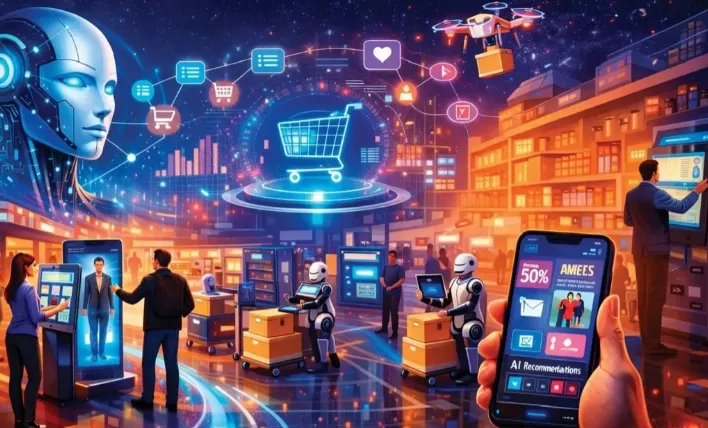
For years, digital retail innovation followed a familiar arc. First came websites, then mobile apps, then personalization layers and retail media networks designed to influence shoppers once they arrived. In 2026, that entire sequence is being upended by a new force: artificial intelligence that doesn’t just recommend products, but actively shops on a consumer’s behalf.
Agentic AI — systems capable of reasoning, decision making and task execution — is rapidly transforming shopping from something that happens inside retail platforms into a destination of its own. According to Coresight Research’s new report, “10 Retail Tech Trends for 2026,” checkout-enabled AI agents represent the opening chapter of what the firm calls an “agentic universe,” where digital assistants manage discovery, comparison, purchase and even post-purchase support.
“The transition from traditional Web or app search to agent-led commerce represents the next great evolution in retail,” said John Furner, president and chief executive officer of Walmart U.S. and incoming president and CEO of Walmart. “We aren’t just watching the shift — we are driving it.”
What makes agentic AI different isn’t just speed or convenience. It’s control. For the first time, the center of gravity in digital commerce is moving away from the retailer’s homepage — and toward the AI systems consumers increasingly trust to guide everyday decisions.
Generative AI has already reshaped product discovery. Conversational tools such as OpenAI’s ChatGPT taught consumers to ask questions instead of typing keywords, receiving rich answers that combine recommendations, comparisons and contextual guidance.
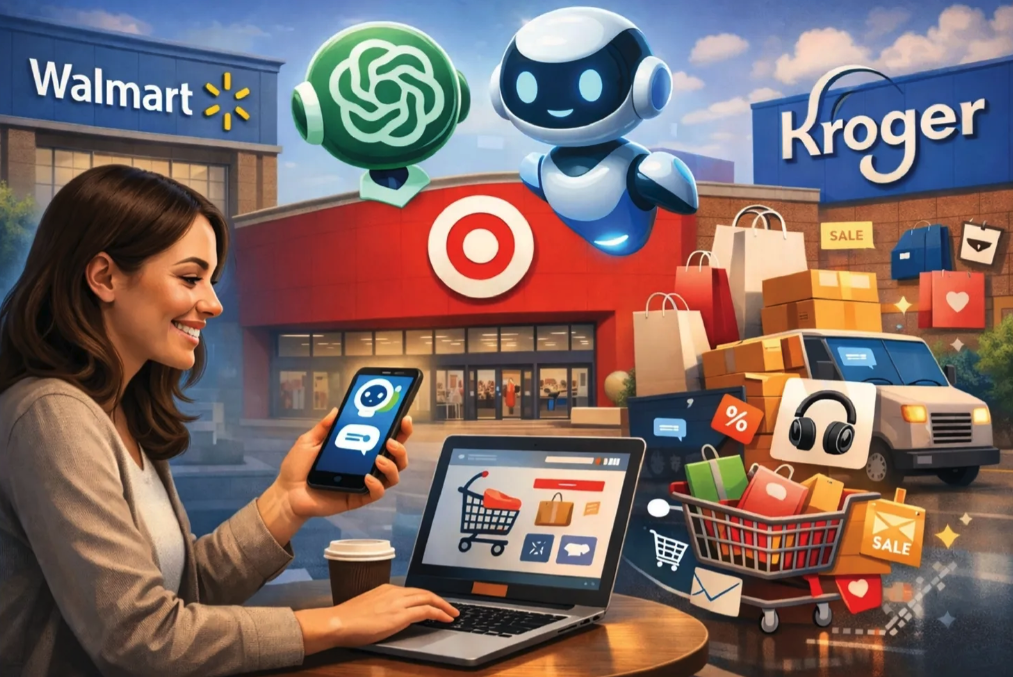
But generative AI stops at suggestion.
“Agentic AI builds on generative AI’s ability to understand natural human language,” said John Harmon, senior analyst at Coresight Research and author of the report. “The difference is that agentic AI can take action on a human’s behalf — and even automatically.”
Instead of simply returning information, agentic systems can operate software, run analyses, verify results and complete tasks end to end. In retail, that means an AI agent can research products, check availability, compare prices, apply loyalty benefits and execute checkout — all within a single conversational experience.
“I view it as a new programming paradigm,” Harmon said. “Rather than writing code, you give the agent instructions in natural language. It interprets them, figures out what to do, and checks its own work.”
This ability to reason and verify is critical. While generative AI can hallucinate or return inaccurate results, agentic systems are designed to validate actions before executing them, making them more suitable for commerce, logistics and financial transactions.
That future moved from theory to reality on September 29, 2025, when OpenAI announced an agentic commerce platform developed in partnership with Shopify and Etsy. Subsequent integrations with Salesforce’s Agentforce Commerce and Walmart quickly followed.
“It’s really only about four months old,” Harmon said, “but it’s moving incredibly fast.”
The momentum is backed by scale. Coresight estimates U.S. retail sales at $5.5 trillion, while OpenAI reports roughly 800 million daily users across its platforms. Even before checkout was enabled, consumers were using AI chatbots for research and comparison.
“If you ask ChatGPT to help you look for a product, the answer is really rich,” Harmon said. “It shows pictures, key features, selling points and recommendations. It offers more information than a traditional search engine ever did.”
Agentic commerce simply removes the final barrier — the need to leave the conversation to complete the transaction.
For retailers, this shift represents more than a new channel. It challenges the very mechanics of digital discovery.

“You saw at the end of last year a lot of swirl and excitement among retailers trying to make sure they weren’t going to be left out,” said Justin Honaman, global head of retail, restaurants and consumer goods business development and growth at Amazon.
Honaman described a world in which traditional search engine optimization is giving way to something new: answer engine optimization, or AEO.
“When an agent goes out and looks for a product for you, it’s not looking at favorite colors or brand storytelling on your website,” he said. “It’s looking at the data. It’s searching in a different type of way — and allowing you to transact on that platform.”
That raises a fundamental question: Who owns the customer relationship when discovery and purchase happen inside an AI interface?
Amazon’s response has been to embrace the shift head-on. Honaman pointed to initiatives such as Buy for Me, which allows Amazon’s search engine to locate products outside its own marketplace and bring them back for transaction or, alternatively, hand shoppers directly to the retailer through ShopDirect.
“There’s so much change and dynamic movement right now in the world of search,” Honaman said. “Retailers really do need to be leaning in on this.”
Walmart is leaning in aggressively — not by defending its digital perimeter, but by embedding its ecosystem directly into the agentic layer.
At the National Retail Federation’s Big Show in January, Walmart and Google announced plans to launch a new shopping experience built directly within Google’s Gemini AI, using the Universal Commerce Protocol (UCP). The integration pairs Gemini’s intelligence with Walmart and Sam’s Club’s assortment, pricing and fulfillment capabilities.
Under the new experience, Gemini will automatically surface Walmart and Sam’s Club products when relevant. A shopper asking about spring camping gear, for example, will see items pulled directly from Walmart’s in-store and online inventory — with more opportunities for product discovery as the conversation evolves.
Personalization is central. When customers link their accounts, Walmart can recommend complementary items based on past in-store and online purchases; merge Gemini-inspired items with existing carts; and apply Walmart+ and Sam’s Club membership benefits automatically.
Speed remains a differentiator. Walmart’s local fulfillment network enables delivery in under three hours — and as fast as 30 minutes in selected markets — ensuring that agentic shopping doesn’t sacrifice immediacy.
“We want to help customers get what they need and want, when and where they want it,” Furner said. “Partnering with Google to bring the Walmart experience directly into Gemini is another step toward making shopping more intuitive and personal.”
Walmart’s Gemini integration is part of a broader push by Google to establish agentic commerce as an open, interoperable ecosystem rather than a closed platform controlled by a single player.
The UCP introduced by Google is an open standard designed to allow AI agents to operate seamlessly across discovery, checkout and post-purchase support. UCP establishes a common language for agents, retailers and payment providers, reducing the need for custom integrations.

The protocol was co-developed with Walmart, Sam’s Club, Shopify, Etsy, Target and Wayfair, and endorsed by more than 20 companies across payments and retail.
“AI can improve every step of the consumer journey, from discovery to delivery,” said Sundar Pichai, CEO of Google and Alphabet. “Customers will soon be able to experience everything they love about Walmart directly in the Gemini app.”
Initially, UCP will power checkout in Google’s AI Mode in Search and the Gemini app, with loyalty rewards and related-product discovery planned for future phases.
Walmart’s work with Google wasn’t the only partnership between a retailer and technology company that was in the spotlight at NRF’s Big Show. Executives from Target and OpenAI discussed the discount store operator’s ongoing tech-led transformation, one which will impact every aspect of the business. The initiative is designed to empower the workforce, improve operational efficacy and enhance the shopping experience.
“The transformation is real,” said Prat Vemana, executive vice president and chief information and product officer at Target. “The pace of change right now is the fastest we’ve seen in a few years. At Target, we are positioned to win, with a very clear focus on merchandising authority, which is our style and design. That’s our roots. And we are known for an elevated guest experience. Both are really powered by Target technology.
“Within my teams, we talk about this transformation as moving from using AI to run on AI. So, when you move from using AI to run on AI, it allows us to actually modernize the underlying, foundational systems. It also allows us to innovate really fast. That means that we could amplify the talent, and power our team members very differently, our guest experiences very differently, and the partners who do business with Target.”
OpenAI, the company that first brought AI into the mainstream, is one of the retailer’s most important partners. In November, the companies announced that consumers can discover items and shop Target inside the ChatGPT platform. Billed as a curated, conversational experience, the app allows customers to receive personalized recommendations, purchase multiple items in a single transaction, and choose among drive-up, pickup or shipping options for order fulfillment.
The addition of Target to ChatGPT is the latest result of the ongoing collaboration.
“Target is leading the pack,” said Ashley Kramer, vice president of enterprise at OpenAI. “They started with a Chat pilot, which we run together, that helps them understand how they can be successful. It will always start with productivity and making sure everybody’s comfortable with the technology. And then Prat had very specific KPIs for the company and strategic initiatives.
“So, we were able to look at what processes we can optimize — Joy[a chatbot that answers questions from Target’s business partners] and Trend Brain[a trend intelligence platform for merchants and designers], amongst many. Now we’ll go deeper into what we can infuse in products. How can we really elevate the customer support experience?
“There are all these different things we can do together. Prat didn’t come to me and say, ‘I want to do all these things right now.’ We’re building it together. What was beautiful about that is when we were ready to build an app ecosystem on the consumer side, it was a no-brainer to give Target a call to be one of our launch partners.”
Also in January, Kroger announced an expanded relationship with Google Cloud, rolling out Gemini Enterprise for Customer Experience nationwide. The initiative combines a Meal assistant and a Shopping assistant, designed to simplify grocery planning without sacrificing personalization.

A single request like “I want to prepare vegan tomato soup” can be transformed into a guided recipe with a complete ingredient list, added to a cart in one click. The system can also reorder past purchases, build complex carts for special occasions or compare products across Kroger’s assortment.
What makes the assistant powerful, Cosset emphasized, is that recommendations are grounded in Kroger’s real-time pricing, availability and loyalty data.
One of the most closely watched questions in agentic commerce is whether large retailers will gain an insurmountable advantage due to their ability to invest at scale.
Jill Standish, global retail lead at Accenture, sees a more nuanced outcome.
“What I’m seeing is that these agents really don’t care about the size of the retailer,” Standish said. “They look at reviews, what’s trending, and all sorts of data around products in the market.”
Standish pointed to OpenAI’s partnerships with Shopify and Etsy as a critical development.
“That’s real organic search and discovery rather than paid search,” she said. “In the past, if I searched for coffee mugs, a big-box retailer would come up first. Now, maybe it’s an artisan producing handmade mugs.”
In that sense, agentic commerce could level the playing field, allowing smaller brands to surface organically, based on relevance rather than ad spend.
“Consumers will have more opportunity for discovery,” Standish said.
As discovery migrates to AI platforms, the question of customer ownership becomes unavoidable.
“You have to play in both,” Standish said. “If you’re a brand, you need conversational recommendations on your own website — that’s what you control. But you can’t control where consumers start their discovery.”
For mid-tier and small companies without multimillion-dollar technology budgets, partnerships are emerging as the primary path forward.
“Collaborating is going to be the way to go,” Standish said. “Look at Etsy and Shopify — and now Etsy, Shopify and ChatGPT together. Don’t try to go it alone.”
Platforms, she argued, lower the barrier to entry by handling discovery, fulfillment and infrastructure — allowing brands to focus on product and storytelling.

Agentic AI’s impact won’t stop at shopping interfaces. Standish pointed to two emerging frontiers: physical AI and synthetic AI.
Physical AI includes digital twins of warehouses and distribution centers, where AI simulations model the movement of people and robots to improve efficiency.
Synthetic AI, meanwhile, allows retailers to test pricing, advertising and product concepts using AI-generated focus groups — predicting performance before launch.
Together, these capabilities suggest that agentic AI will shape not just how consumers shop, but how retailers plan, operate and innovate.
As agentic AI matures, shopping may no longer begin with a homepage, an app or even a marketplace. Instead, it will begin with a conversation — one that seamlessly moves from inspiration to purchase to delivery confirmation.
For retailers, the challenge will be preserving brand identity, data access and customer relationships in a world where AI mediates discovery. For consumers, the appeal is already clear: less friction, more relevance and a shopping experience that feels effortless.
Agentic AI isn’t just changing how people shop.
It’s redefining where shopping happens — and who, or what, is doing the buying.
Submit Your Press Release
Have news to share? Send us your press releases and announcements.
Send Press Release