


WASHINGTON — The Council for Responsible Nutrition (CRN) commends the new clarity provided by the U.S. Food and Drug Administration regarding how dietary supplement companies can present the required Dietary Supplement Health and Education Act (DSHEA) disclaimer on product labels. They describe this development as a long-sought victory for regulatory consistency and consumer understanding.
For nearly thirty years, FDA practice has allowed an asterisk directing consumers to a single, full DSHEA disclaimer elsewhere on the label, in accordance with section 403(r)(6)(C) of the Food, Drug, & Cosmetic Act and 21 C.F.R. § 101.93(d). However, an emerging wave of class-action lawsuits has challenged this approach, asserting that the full disclaimer must be present on every panel where a structure/function claim is made. CRN and other industry groups warned that such an interpretation would cause confusion, lead to unnecessary legal actions, and place disproportionate burdens on compliant manufacturers without actually enhancing transparency for consumers.
Earlier this year, CRN urged the FDA to revise section 101.93(d) to state that duplicative disclaimers are not necessary to be clearly stated. In a regulatory submission, the association argued that a single disclaimer, effectively linked by an asterisk or similar symbol, fully meets legislative intent and maintains essential consumer protections while removing redundant labeling requirements. CRN also emphasized that it is willing to escalate the issue through a citizen petition if needed.
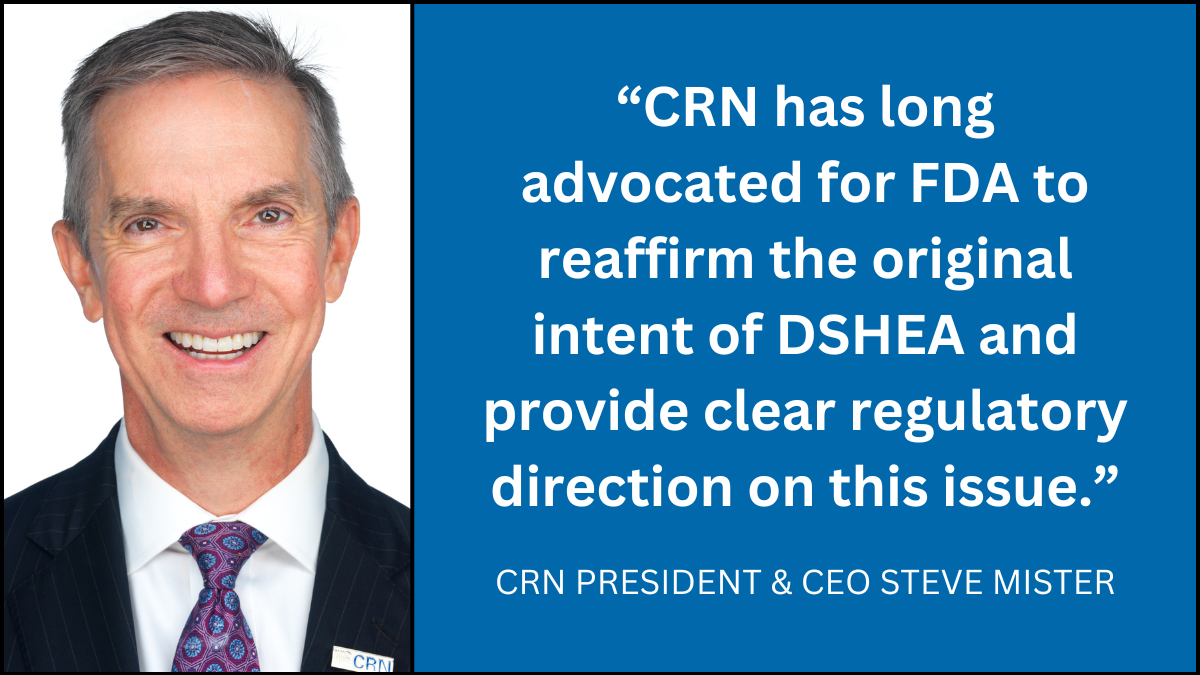
“CRN has long advocated for FDA to reaffirm the original intent of DSHEA and provide clear regulatory direction on this issue,” said Steve Mister, CRN President and CEO. “We welcome FDA’s attention to this matter and appreciate the opportunity to support the agency in recognizing the practical, commonsense approach that consumers and companies have relied on for nearly three decades. Consistency in labeling standards strengthens consumer confidence and supports a stable regulatory environment.”
Megan Olsen, Senior Vice President and General Counsel at CRN, stated that the clarification aligns FDA practice with the statute while reducing ambiguity that has fueled opportunistic lawsuits.
“For years, FDA’s implementation has allowed companies to use an asterisk to direct consumers to the disclaimer, and that approach is fully consistent with DSHEA,” Olsen said. “Clear guidance helps ensure that companies can meet their obligations without unnecessary litigation risk, while still providing consumers with accurate, meaningful information. We appreciate FDA’s willingness to revisit this issue and apply a clear, legally sound interpretation moving forward.”
CRN described the development as a significant move toward clearer regulations that promote compliance, consumer access, and trust in the marketplace for millions of Americans who depend on dietary supplements daily.