
NASHVILLE, Tenn. — For decades, the local grocery store has quietly served as one of the most-visited institutions in American life — more frequented than the doctor's office, more trusted than the hospital. Now, a cohort of regional supermarket operators is making the case that the corner store should become a cornerstone of the U.S. healthcare system.
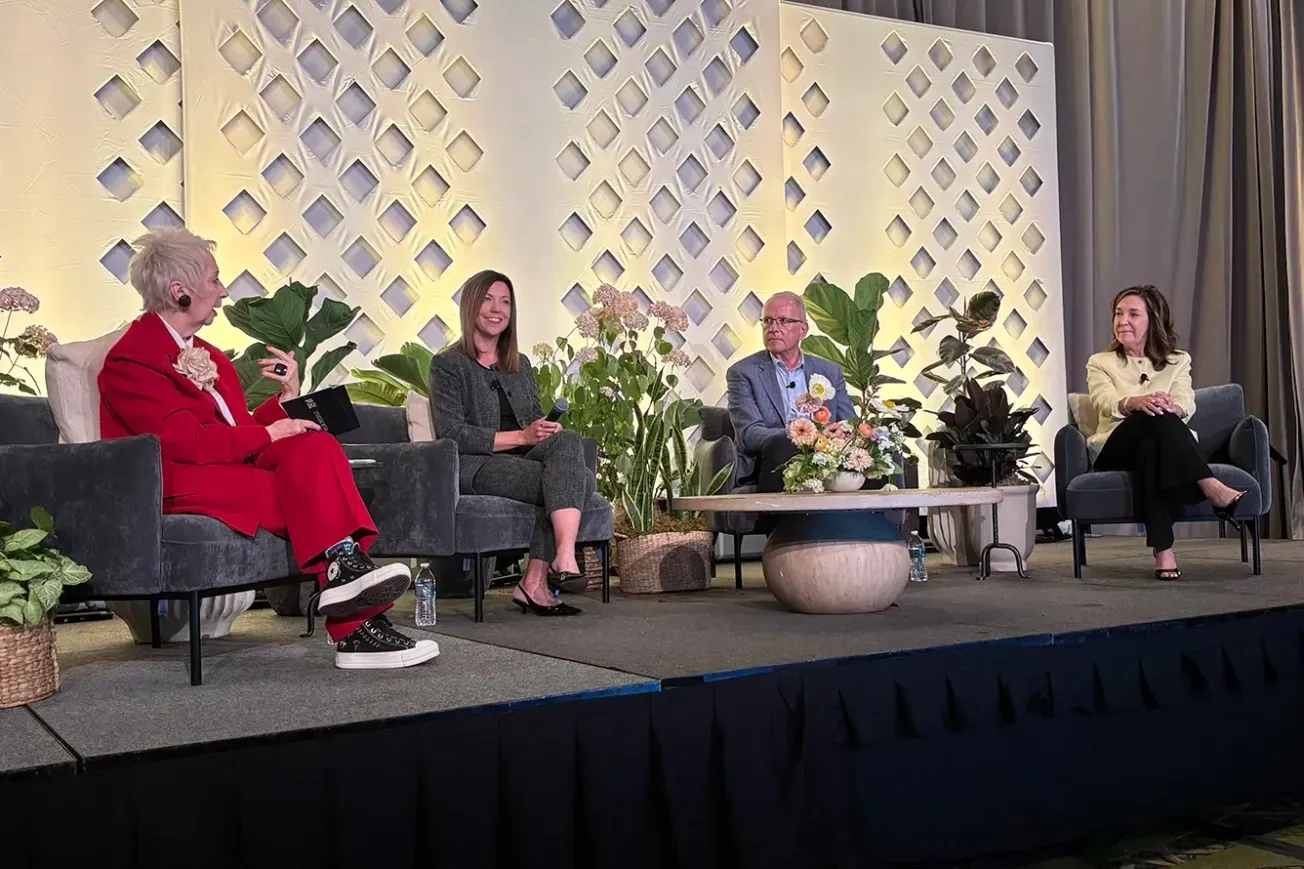
At this week's Future of Commerce 2030+ conference, hosted by The Emerson Group (in conjunction with retailmedia IQ and WSL Strategic Retail), executives from Kroger Health, Hy-Vee, and Wakefern Food Corp. described an accelerating convergence of food retail and healthcare delivery that, they argued, has never been more urgent — or more possible.
"I really believe that from primary care providers all the way to government officials, people are understanding that healthcare needs to be delivered in the third place," said Colleen Lindholz, president of Kroger Health, suggesting need for an option beyond the doctor's office or the hospital. "The third place would be retail, and that means bringing everyday health to where people eat, live, drink, breathe, and trust."
Two Decades in the Making
The food-as-medicine movement didn't emerge overnight. Lindholz noted that Kroger launched its nutrition-scoring program — called OptUp — back in 2013, and that the broader cultural conversation around food as a preventive health tool had been building for roughly two decades, even if mainstream retail attention arrived only in the past four or five years.
That momentum is now institutionalized. The Nourishing Change conference, which Kroger hosted last year, passed the baton to Hy-Vee this year and will move to Ahold Delhaize in 2026 — a deliberate effort to spread the framework across competing chains.
"We are competitors coming together," said Mike Stigers, president of Wakefern, the cooperative that operates ShopRite stores across the Northeast. "We are an industry coming together to address significant issues."
Hy-Vee, the Midwestern chain, has employed registered dietitians for 25 years and pharmacists even longer. But Angie Nelson, the company's vice president overseeing pharmacy and health services, said the real shift came when those clinical silos were broken down and integrated into a unified wellness strategy spanning the entire store.
"We really weren't merging everything," Nelson said of the earlier model. "Over the last decade or so, we've worked to think of wellness as an entire strategy for Hy-Vee — one of our top strategies."
Today, Hy-Vee's dietitians and pharmacists co-sign product signage in the aisles, lending clinical credibility to purchasing decisions. Nelson said those endorsed items see sales lifts exceeding 25 percent. The chain has also signed agreements with health plans and a federal technology partner that pay for both approved grocery lists and dietitian consultations — with patients earning in-store rewards for completing the visits.
GLP-1 Drugs Rewrite the Shopping Trip
The panel spent considerable time on the compounding effects of glucagon-like peptide-1 (GLP-1) drugs — weight-loss and diabetes medications such as Ozempic and Wegovy — which are rapidly altering what Americans buy, how they shop, and what kinds of support they seek from their pharmacist.
Early GLP-1 adopters arrived at pharmacy counters quietly, often seeking help managing side effects rather than advertising their prescriptions. That has changed. "More and more, we're seeing people be more bold about being on a GLP-1 and asking questions," Nelson said.
Hy-Vee responded by clustering GLP-1-related products near pharmacy counters, enabling pharmacists to answer questions while customers browse. It has also begun flagging the 90-day mark in patients' prescription journeys — a point at which side effects often intensify and adherence drops — as a trigger for proactive outreach.
Kroger's Lindholz said the chain is developing what it calls a concierge service for GLP-1 patients, modeled on the specialty drug "hub" model used for high-touch therapies, where pharmacists maintain closer contact with patients to help them navigate side effects and avoid discontinuation.
"A lot of people are falling off the drugs," she said. "They don't want to go off, but they can't handle the side effects. Those effects can be mitigated with the right amount of fiber, protein, and even titrating down to a lower dose — but it takes someone talking to them."
Meanwhile, the broader shift in consumer mindset driven by GLP-1s is reshaping basket economics across the store. Lindholz pushed back on fears that thinner, less-hungry consumers would simply spend less. "They're trading up," she said. "They're buying natural and organic, better-for-you. They're more engaged with beauty. They're spending more dollars." Wakefern's Stigers added that protein, fiber, hydration, and exercise have become the four organizing principles around which his buyers now build ad programs.
Technology as Clinical Infrastructure
Handling the volume of health-related interactions at the pharmacy counter requires workflow engineering, not just goodwill. Kroger has built clinical queuing systems that surface tasks — a dietitian referral flag, an A1C test prompt — precisely when a relevant patient approaches the counter. The chain is also piloting dietitian-endorsed shelf tags under the OptUp scoring system throughout the store, a way of extending clinical guidance beyond the pharmacy without requiring a face-to-face interaction.
Lindholz said Kroger is entering a new phase of personalization this quarter, beginning to cross-reference grocery purchasing data with pharmacy records — with explicit customer consent — to enable targeted outreach and cross-category promotions. "Get ready for cross-promotions, bundling-type deals," she said. "It's also what you put on your body, not just what you put in it."
Looking further ahead, she described work on a "health passport" — a portable, patient-owned data record that would allow consumers to share their health information with providers of their choosing. "If I want to give my data to somebody because I need help at that time, I ought to be able to share it," she said. "It will open up the opportunity for people to get help faster, to get on therapy faster."
The Community Mandate
Beyond commercial strategy, each executive returned repeatedly to a more elemental argument: that regional grocers occupy a unique position of social trust, and that this position confers responsibility.
Stigers described converting a hotel ballroom at a Wakefern-sponsored golf tournament into a free dental clinic — six dentists, 30 hygienists, hundreds of inner-city children, including special-needs patients seen through the New Jersey Special Olympics. A child who had endured weeks of pain from an impacted tooth received her first-ever dental extraction. Another child, offered a toothbrush and toothpaste at the exit, asked: "Is this my own? I don't have to share this with my brother?"
"That's what our companies do," Stigers said. "And our entire industry does this every single day."
Hy-Vee's Nelson described the company's CEO Jeremy Gosch as "very passionate" about ensuring no child in the chain's trade area goes home hungry after school — a commitment the company is acting on by opening food pantries in low-income communities and embedding dietitians in those programs to add nutritional education alongside food access.
The panel's moderator, WSL Strategic Retail CEO Wendy Liebmann, drew on her upbringing in a small Australian farming town where she knew the pharmacist and the grocer by name — an experience she argued made real the abstract concept of retail as community infrastructure.
"The power of the local community and the local retailer," she said, "the laying on of hands that can be had in that world — it is so extraordinary."
Stigers put a harder edge on the same idea: "In the case of a national disaster or a natural emergency, the local grocery store is the last to close and the first to open. If you want to see a real crime in a community, close the local grocery store."
A Call to Suppliers
The executives closed with a direct appeal to the consumer goods companies, health brands, and OTC manufacturers in the audience. Stigers asked suppliers to push harder on education — to treat retailers as students, not just shelf space. Lindholz asked them to come not just with products but with solutions, and to prepare for a new era of consent-based personalization that would enable far more precise targeting than today's circular promotions. Nelson urged the audience not to underestimate what a regional grocer could actually execute.
"Don't underestimate what we can do and the impact we can have," she said. "We're agile. Come to us with the opportunities, because we want to impact the health and wellness of the communities we serve. We're standing here asking you to come to us."