

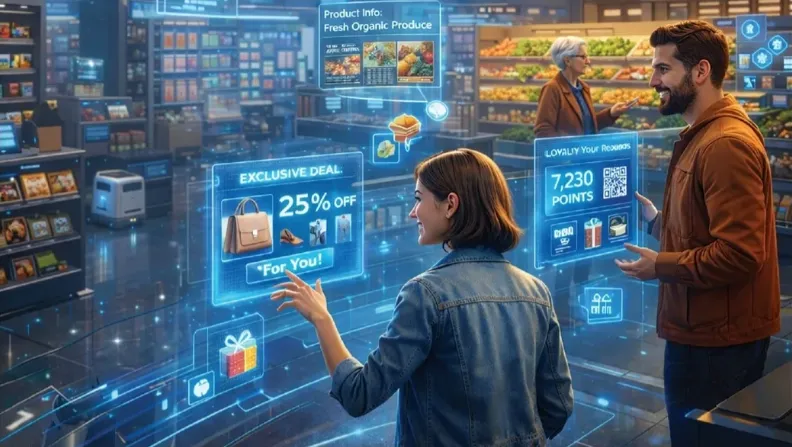
Agentic commerce gets the headlines, but retailing’s age of artificial intelligence is also shaped by in-store technologies that help retailers bridge the physical and digital worlds to accelerate problem-solving, improve productivity, and guide and train employees.
UiPath Inc. is a leader in agentic automation, providing software used to build and orchestrate AI agents that automate complex business processes and workflows. Its UiPath Platform for Agentic Automation and Orchestration was named one of 2025’s Best Inventions by Time magazine and is used by companies in several industries and by the federal government.
Clients in the retail and CPG sectors use UiPath’s merchandising solution to autonomously manage decisions, cutting through complexity around demand volatility, abbreviated product lifecycles, pricing and promotions.
The platform uses prediction models to autonomously make decisions that otherwise would rely upon static tools and delayed data, according to the New York–based company. The UiPath Solution for merchandising embeds intelligence directly into the merchandising workflow. It continuously predicts what’s likely to happen, decides the best actions to take and executes these autonomously within defined business parameters. “Better than reacting to yesterday’s numbers,” the company says. “Faster, more confident trading decisions, less manual work, better return on investment.”
Microsoft Corp. embeds AI at the core of store operations with Dynamics 365 Commerce and other solutions that bring operations into clearer focus and accelerate data-driven decision making.
Augmented reality (AR) and other tools help retailers build AI-driven storefronts, with unified in-store, back office and digital experiences that optimize operations and personalize customer engagement. Microsoft says the embedded AI equips associates with predictive intelligence, actionable workflows and real-time business alerts.
Microsoft sees a growing interest in AR as part of an expanded AI ecosystem for businesses that see value in creating immersive experiences for consumers and employees alike. Retailers including Walmart use AR to improve store operations, supply chain efficiency and digital asset creation. Walmart built an internal AR platform named Retina that advances its “adaptive retail” strategy by helping to standardize and speed up creation of digital representations of products and store environments, directly benefiting operational consistency across stores and online channels.
General Robotics Technology Inc. is building AI systems that allow robots to sense, reason and act effectively in real‑world environments. Rather than focus on a single robot hardware platform, the Redmond, Wash.-based company offers a scalable intelligence layer that can power robots of all forms.
Its General Robot Intelligence Development (GRID) platform is leading the shift “from bespoke machines to true physical AI,” empowering retailers to deploy autonomous intelligence to improve inventory management and automate repetitive pick-and-place tasks as they move beyond single-purpose automation toward fully autonomous warehouse operations.
Skild AI Inc. is another start-up focused on AI’s potential to improve robotics. The Pittsburgh-based company is pursuing robotic intelligence that learns and adapts across environments and tasks.
Cimulate Inc. helps retailers and brands gain competitive advantage in AI-native shopping environments. The Boston-based start-up has launched CommerceGPT, a context engine designed to help retailers show up, convert and thrive in a world where agents — not people — drive discovery.
Rather than rely on clickstream data, CommerceGPT simulates millions of shopping journeys to create synthetic behavior that trains its models to understand nuance, intent and conversion at scale. The data is then tailored to each brand’s product catalog and shopper context to drive customers to checkout.
The future of commerce won’t be driven by better filters or keywords, says Vivek Farias, a Cimulate co-founder and professor at MIT. It will be driven by agents trained on large language models to reason, recall and recommend. “LLM-based search is no longer a futuristic luxury — it’s a necessity for brands that want to stay ahead,” the company says.
Impinj Inc. is an internet of things (IoT) pioneer and proprietor of the RAIN RFID platform that helps retailers and manufacturers connect everything they make, transport and sell. The flexible, low-cost, wireless technology identifies what an object is, where it is in a supply chain and even its condition — all in real time.
The company, founded in 2000 in Seattle, also offers the Impinj Gen2X solutions toolbox that encompasses key breakthroughs developed over two decades working with Fortune 500 enterprises to solve previously unsolvable use cases. The innovations help prevent counterfeits from entering the supply chain, the company says.
Another feature, Impinj Protected Mode, is used to switch an RFID tag from readable to invisible and back again, allowing retailers to prioritize consumer privacy while preserving the tag’s functionality in various retail processes, including optimizing inventory, streamlining sales, loss prevention and returns.
Submit Your Press Release
Have news to share? Send us your press releases and announcements.
Send Press Release