
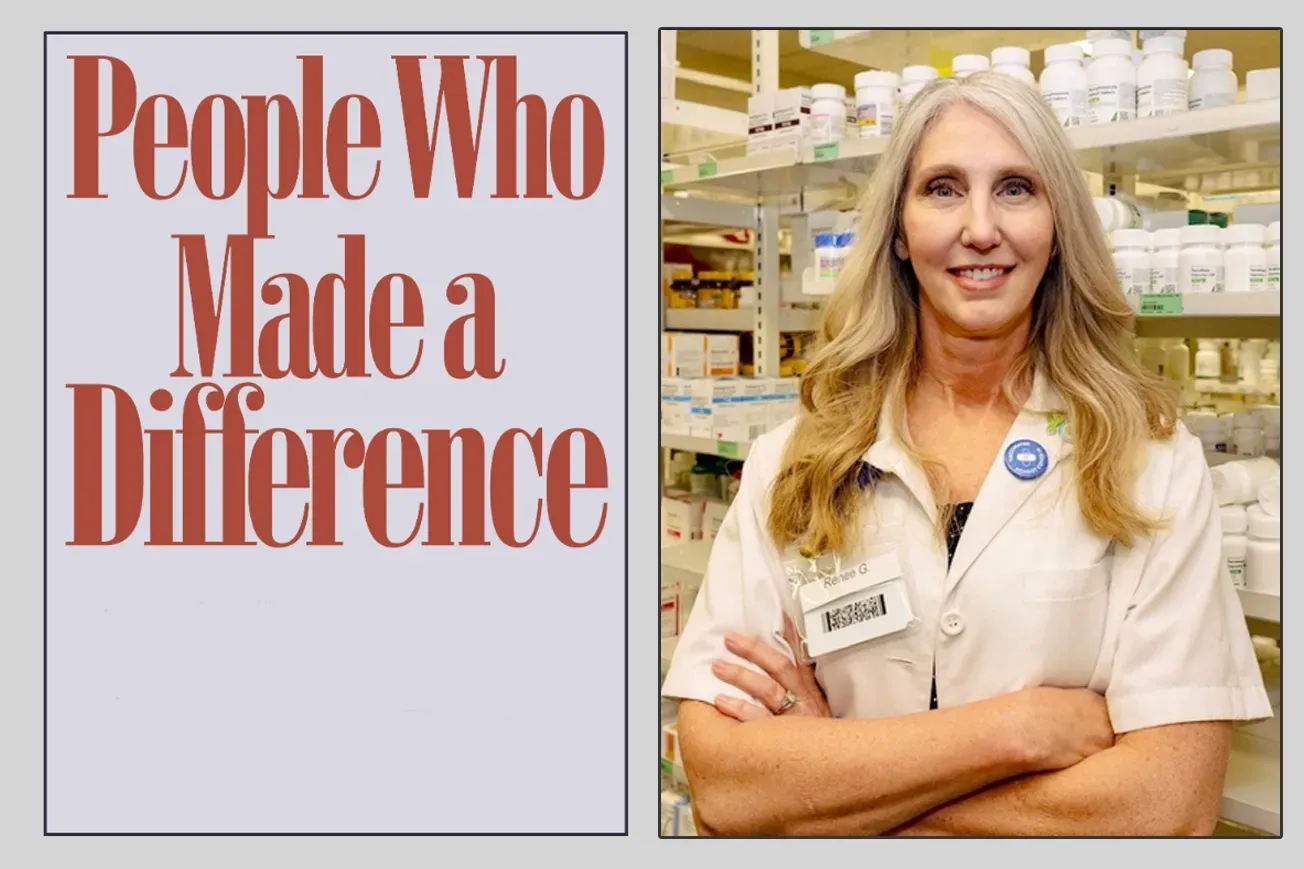
Renee Guthrie is passionate about helping patients stay on track with their medications.
As lead pulmonary and transplant pharmacist for Walgreens Specialty Pharmacy in Kansas City, Guthrie strives every day to ensure patients with complex, chronic and rare conditions get essential care. She forms personal connections with her patients by offering tailored education, in-depth consultations and hands-on support with new medications, including injection training and side effect management. Coworkers describe her as someone who puts her whole heart into everything she does and who finds a solution to the most difficult problems.
Her task is especially challenging for transplant recipients, but Guthrie is dedicated to helping give them a new lease on life.
| Click here to see all the People Who Made a Difference |
The most common transplants are of the kidney, heart and liver, and a patient getting any of those organs can initially be on many drugs. “It’s all new to them,” she says. “So we help get them get started with all the medications.”
That includes a benefits investigation, to make sure everything is covered by insurance. Once all the prior authorizations are received, Guthrie ensures that all the drugs have been picked up or delivered, “and then we’re here to answer any questions” that patients have. “Things change a lot after the beginning stage, so we’re on call to ease any anxieties that come up.”
Guthrie also deals with patients with respiratory conditions, and she says that to optimize their care “I really get to know them and their lifestyles, and they learn about me. I’m their contact month to month, so we get to know each other.”
Medications for respiratory diseases range from injections for asthma to drugs for cystic fibrosis and pulmonary fibrosis.
The life expectancy for people with cystic fibrosis has doubled over the course of Guthrie’s career, “so it’s amazing to see,” she says. “It’s remarkable how much the therapy has been streamlined and is really helping patients.”
Treatment still requires extensive lifestyle management, she notes, but patients can live full lives with support from their doctors and respiratory therapists along with medication management from specialty pharmacists like herself.
Guthrie’s personal support led to her winning Walgreens’ Act of Heroism award for unwavering dedication to a patient at a trying time. During routine check-in calls, she learned from a parent that the teenage patient had run away from home. Knowing that his respiratory condition required “limited distribution” medications, which were only available at certain pharmacies, she felt compelled to help him.
“I knew that he wouldn’t be able to get his meds anywhere else in his area,” says Guthrie. “So I asked his caregiver about what he was doing. It turned out he was still going to school, so I thought about the options. The next day I reached out to his school nurse, who said she had his meds for the short term. And between the nurse and me, we came up with a plan to ship the medications to her to keep him on therapy.”
Greater adherence would significantly reduce hospitalizations, she notes. “That’s why my team calls patients every month to ask if they’re ready for refills. We ask how they’re doing, if they’ve started any new medications, and how many doses they’ve missed. Just asking those questions can increase adherence drastically — just talking month to month.”
Asked about the difference between specialty pharmacy and conventional “corner store” pharmacy, she says each has its own differences. The main difference might be the time required for each patient, with specialty pharmacy calling for much more in the way of explanations and guidance. “We take a lot of time with our patients,” she says. “We always want to make sure that they know exactly what they’re doing. Because it can be dangerous if they’re not medicating correctly. Just suppose something were to go wrong with a transplant and an organ had to be replaced. So we want to make sure that they are confident in their ability to administer what we’re sending them.”
Her dedication to her job comes from Walgreens’ management down, she says. Guthrie’s directive is “Take care of the patient and do what’s best for them.” Her pharmacy has a lot of pharmacists and technicians, and she says, “I think they all have a story similar to mine, in which they’ve gone above and beyond. It’s just kind of what’s instilled in us and what we do.”