


WASHINGTON — Council for Responsible Nutrition on Tuesday praised the U.S. Department of Health and Human Services and the U.S. Department of Agriculture for recognizing the role dietary supplements can play in helping Americans meet nutrient needs in the newly published 2025–2030 Dietary Guidelines for Americans.
CRN said the updated guidance rightly affirms that nutrient-dense foods should remain the cornerstone of a healthy diet, while acknowledging dietary supplements as a practical, science-based option to address ongoing nutrient gaps across the population.
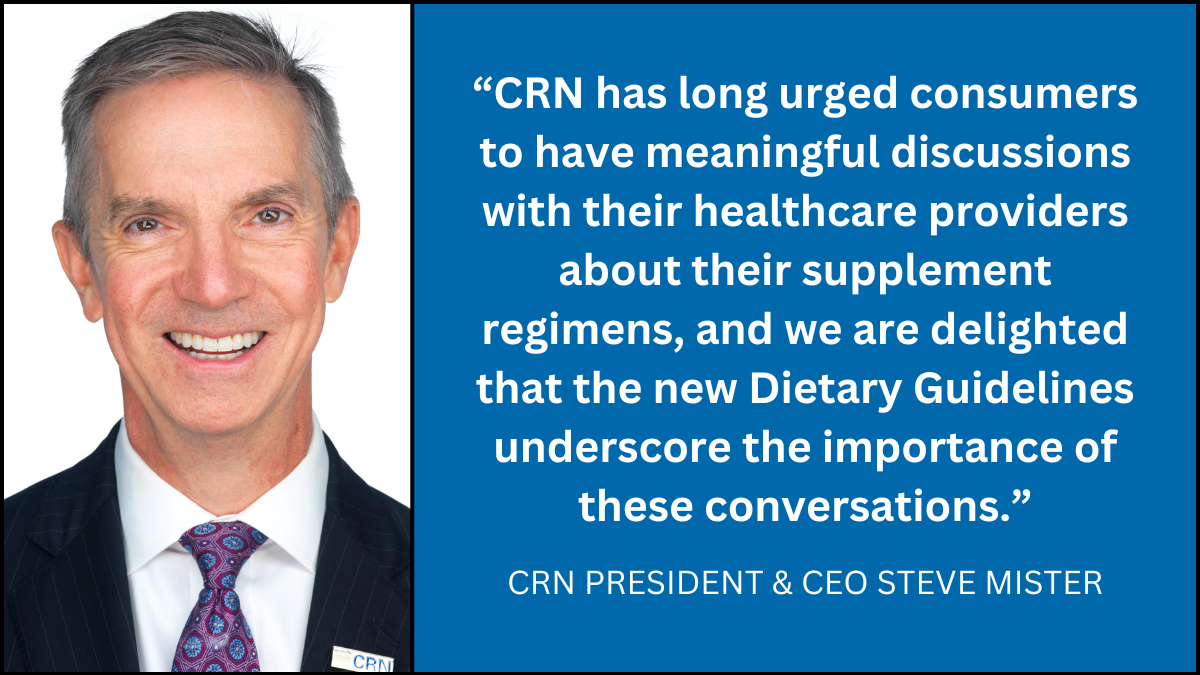
“For many Americans, meeting nutrient recommendations through food alone is challenging, sometimes due to limited food sources, increased nutritional needs during certain life stages, or other real-world barriers,” said Steve Mister, president and CEO of CRN. “By recognizing dietary supplements as a way to help fill nutrient gaps, the agencies have taken an important step toward improving public health and ensuring the Dietary Guidelines are both evidence-based and practical.”
CRN highlighted longstanding evidence indicating that Americans often fall short on nutrients such as vitamin D, calcium, potassium, and dietary fiber. The association stated that appropriate supplement use has been shown to reduce nutrient inadequacy, especially among populations with increased or specific needs.
The new guidelines also continue to acknowledge life-stage-specific considerations, such as infancy, adolescence, pregnancy and lactation, and older adulthood. CRN noted that the guidance aligns with its previous public comments by emphasizing that supplementation for these groups should be done in consultation with health care professionals.
“We support the agencies’ goal of improving the health of American families,” Mister added. “Clear recommendations around the appropriate use of dietary supplements strengthen the Dietary Guidelines and help consumers and health care providers make informed decisions.”
CRN expressed anticipation of ongoing collaboration with federal policymakers to promote nutrition policies that ensure nutrient sufficiency, prevent chronic diseases, and enhance overall public health.