
NEW YORK — Mayor Zohran Mamdani is pressing ahead with an ambitious plan to open city-supported grocery stores across New York City, positioning the initiative as a response to rising food costs while drawing mixed reactions from residents, grocers and industry observers.
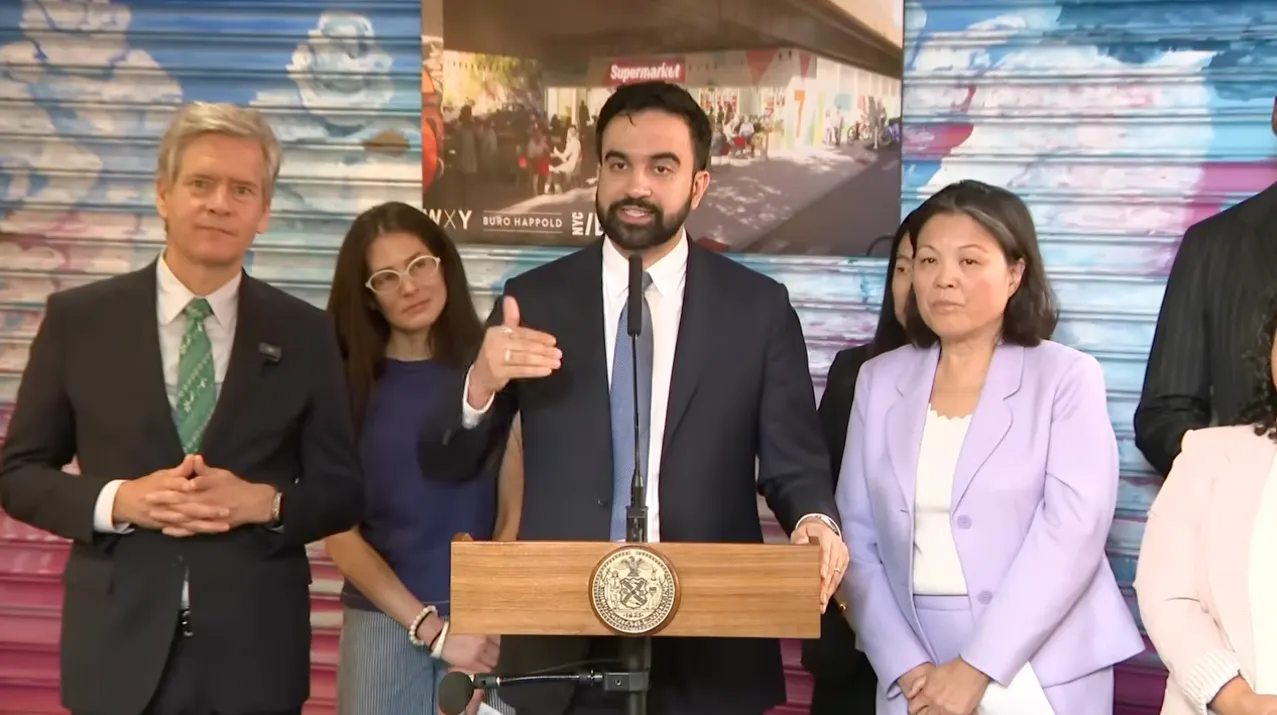
The proposal calls for five stores, one in each borough, with the first tied to the redevelopment of La Marqueta in East Harlem, a city-owned site with historic roots as a public market. Mamdani framed the effort as part of a broader affordability agenda during his first 100 days in office during a press conference on Tuesday.
“I was elected as a democratic socialist, and I will govern as a democratic socialist,” Mamdani said, adding, “Government is a series of choices, and socialism is the choice to fight for every New Yorker.”
A ‘grand experiment’ on affordability
At the La Marqueta site, Mamdani linked the initiative to past public-market efforts in New York City.
“We are all here at La Marqueta at the same site where 92 years ago Mayor Fiorello LaGuardia stood,” Mamdani said, calling the effort “a grand experiment once again.”
The mayor said the plan is designed to counter sharp increases in grocery costs.
“Between 2013 and 2023, grocery prices have skyrocketed in New York City to the tune of nearly 66%,” Mamdani said, describing the rise as “significantly higher than the national average.”
Last year, I told New Yorkers: we would open city-owned grocery stores to take on the affordability crisis.
— Mayor Zohran Kwame Mamdani (@NYCMayor) April 15, 2026
Today, we're delivering five stores — one in each borough — with the first opening next year. We're building a city where people can afford the basics, leave survival mode… pic.twitter.com/s0u7sQjiMI
How the model would work
Under the proposal, the city would subsidize a core basket of essential goods and contract with a private operator to run the stores, with the stores operating under city-defined pricing and labor standards.
“The city will subsidize a core set of food staples,” Mamdani said. “These standards include requirements that at our stores bread will be cheaper, eggs will be cheaper, and grocery shopping will no longer be an unsolvable equation.”
Officials have said that lower operating costs tied to public ownership could help support those price reductions.
“Stores in the NYC Grocery initiative will have low long-term operating costs due to no ongoing rent or property taxes, and those savings will be passed on to the customers.”
However, key details remain unresolved. Mamdani acknowledged uncertainty about pricing specifics, saying, “I can’t give you an exact example of the cost of a cucumber in our essential basket,” while promising “a clear price differential” for core items.
The East Harlem store is expected to cost about $30 million to build, with the broader five-store initiative backed by about $70 million in proposed capital funding.
Residents split on priorities and impact
In East Harlem, reactions have been mixed, with enthusiasm for lower prices and skepticism about neighborhood priorities.
Some local residents say lower costs would be meaningful. Others questioned whether a grocery store is the most urgent investment. “I feel like we should prioritize safety and other environmental concerns in the area rather than a grocery store,” said resident Destiny Louissant, speaking to Gothamist.
Shoppers focused primarily on price competitiveness. “I’ll go wherever it’s cheaper,” one shopper said to NY 1.
Industry pushback and competitive concerns
Local grocers and trade groups have raised concerns about the competitive impact of city-backed stores operating in already tight-margin markets.
Antonio Peña, president of the National Supermarket Association, called the plan “a big slap in the face” for independent operators, while store managers in the area warned that customers could shift to subsidized competitors.
Critics have also questioned whether the city can achieve meaningful cost advantages versus established retailers with scale purchasing power.
“Running a grocery store is a difficult business,” said Doug Rauch, former president of Trader Joe’s, speaking to the Washington Post.
Broader debate over feasibility
Mamdani has acknowledged skepticism but positioned the initiative as a deliberate challenge to private-sector dominance in food retail.
“Now, some will insist that city-owned businesses do not work,” he said. “My answer to them is simple: I look forward to the competition.”
The proposal has garnered support from national political figures, including Sen. Bernie Sanders, who has framed it as both an economic and a public health initiative.
As the city works through outstanding questions about pricing, operations and funding, the East Harlem location is emerging as a test case for whether a publicly supported grocery model can deliver sustained affordability without disrupting the broader retail ecosystem.
Submit Your Press Release
Have news to share? Send us your press releases and announcements.
Send Press Release