

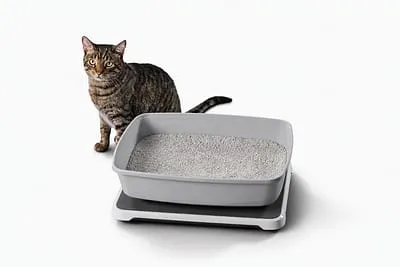
ST. LOUIS – Purina Institute announces a new publication showing that by monitoring a cat's elimination behavior at home, it is possible to pick up subtle changes that may be associated with chronic kidney disease. This retrospective study provided additional evidence for the capabilities of a smart litter box monitor to distinguish meaningful changes as related to chronic kidney disease (CKD) alongside existing data on defecation frequency in cats.
The findings from Nestlé Purina PetCare Global Research and Development together with The Ohio State University, published in Animals, describe how a smart litter box monitor uses load sensors and machine learning to continuously and noninvasively track in-home elimination behaviors — helping caregivers and veterinary teams recognize changes earlier.
Feline CKD is a leading health concern, yet early signs may not be picked up by traditional methods at routine check-ups which provide periodic snapshots. In contrast, smart litter box-enabled monitoring can create a day-by-day picture of urination, defecation, and body weight without disrupting a cat's routine. The system described in the paper classifies events (such as urination, defecation, and non-elimination visits) and can distinguish between multiple cats in the same household, then shares trends through a connected application.
Study highlights
- Retrospective analysis of the smart litter box monitor data from 136 cats, including cats with diagnosed CKD and cats with no known conditions.
- Researchers conducted a comparison of renal CKD and non-renal groups across approximately two dozen monitor-measurable features related to the frequency, weight and duration of elimination events, as well as litter box entry and digging intensity.
- Using a subset of cats for model development and a separate subset for validation, the team built and evaluated a predictive approach intended to flag a behavioral profile associated with CKD.
- The smart litter box monitor was able to detect these behaviors and identify them as indicative of CKD.
- The study supports the potential of passive, in-home monitoring to complement veterinary care by surfacing patterns that may warrant follow-up testing.
"Chronic kidney disease is common in older cats, but it can be challenging for pet owners to recognize early because changes may be gradual and easy to miss in day-to-day life," said Ragen McGowan, at Nestlé Purina PetCare Global Research & Development. "By monitoring elimination behavior and body weight patterns passively in the home, we can identify trends that may signal a need for veterinary evaluation and diagnostic testing. This type of continuous, objective data has the potential to complement routine care — not replace it — by prompting pet owners to have earlier conversations with their veterinarians and follow-up when a cat's pattern changes."
For more information on chronic kidney disease, visit www.purinainstitute.com.